




Tempe Jowo is the name of a fermented tempeh product produced by a small-scale home industry located on Jalan Sedayu Melati RT 02 RW 01, Bangetayu Village (Bangetayu Kulon), Genuk District, Semarang, Central Java. This Tempeh business was founded by Mr. Zaenal Abidin and has been running for 10 years. The main product produced is soy-based tempeh processed using traditional fermentation methods, so that it is able to maintain its distinctive taste and natural quality. Tempe Jowo has been known among the local community for its soft texture and authentic taste. However, despite having been established for quite some time, this business is still stagnant and has not shown significant improvements in production or marketing aspects.
In its operations, Tempe Jowo still relies on manual production processes without the support of modern equipment, resulting in low production efficiency, labor requirements that require more effort, and limited production capacity. As demand for tempeh in Semarang and its surrounding areas increases, the business faces challenges in optimally meeting market demand. Therefore, modernization of production technology is needed to improve efficiency and product quality so that the business can grow more rapidly. Furthermore, Tempe Jowo plans to diversify its business by producing tempeh chips as an additional processed product. This step aims to increase the added value of the product, extend the shelf life of tempeh, and create job opportunities for the local community, especially those who are unemployed or affected by layoffs. With this innovation and digital marketing methods, it is hoped that Tempe Jowo can reach a wider market and increase its competitiveness in the snack food industry.
Tempeh Jowo production still has limited capacity, with an average processing of 40-50 kg of soybeans per day, resulting in approximately 130-150 packages of tempeh ready for sale. Mr. Zaenal’s business is assisted by four permanent workers, with production time ranging from initial production to market readiness of approximately 1-2 hours. These workers only work briefly to assist with the washing and packaging of tempeh, which requires a fast, manual process. Although customer demand reaches 300-500 units per day/week, limited manpower and production facilities often hinder the fulfillment of large orders. Furthermore, the manual production process results in a loss rate of approximately 20% compared to using machines. This undoubtedly impacts the efficiency and profitability of the business. Nevertheless, Tempeh Jowo has significant potential for growth.
The abundant availability of soybean raw materials from local suppliers ensures production continuity, while market demand continues to grow, particularly from loyal customers in traditional markets and food stalls. Furthermore, opportunities for expansion into a wider market are increasingly open with more modern packaging innovations, which can increase the product’s appeal and sales value. Current tempeh packaging is still plain plastic, which is unattractive, so branding is needed to introduce the product to the public. To support business growth, Tempe Jowo also plans to diversify its product offerings by producing tempeh chips to encourage workers to work longer hours and thus increase their wages. This move aims to reach new market segments.
Tempeh Jowo’s production process is still manual, which is time-consuming. Peeling soybean skins is still done by hand, making it less efficient and resulting in a less hygienic product. Furthermore, the soaking, boiling, and packaging of soybeans still rely on simple equipment, resulting in suboptimal production times. To improve efficiency and hygiene, additional equipment such as soybean washing machines is needed in the tempeh processing industry. The sometimes-slow tempeh market needs to be addressed through product diversification, such as the production of tempeh chips. However, processing tempeh into chips has not been realized due to limited equipment and a lack of knowledge and skills for large-scale production. Furthermore, the resulting tempeh has a relatively short shelf life due to the lack of optimal packaging techniques. Furthermore, tempeh chip production requires higher standards to produce a crispy, long-lasting product that is competitive in the market. Business management and marketing are also challenges for Tempeh Jowo. Currently, marketing is limited to traditional markets and has not yet fully utilized digital platforms.
The product’s branding and packaging design are still less attractive, resulting in relatively low competitiveness compared to similar products on the market. Furthermore, a limited distribution network makes it difficult for the product to reach a wider market. However, with its potential, tempeh chips can be developed as a superior product marketed more widely, including through e-commerce and souvenir shops, thereby increasing business competitiveness in the snack food industry. From this situation, it can be concluded that there are three challenges facing partners. The first is the production aspect, which still uses manual equipment. The second is business management, which needs to be improved to increase revenue. The third is product marketing, which does not yet use a digital system and is still focused on the local market.
Based on the solutions offered to address partner issues, socialization, training, technology implementation, mentoring, evaluation, and program sustainability are required to ensure program success.
Socialization
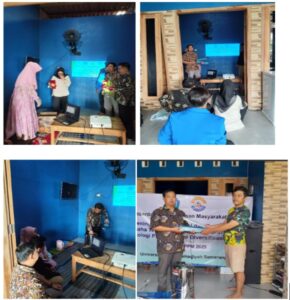
The initial stage involves socialization to “Tempe Jowo” tempeh business partners regarding the objectives, benefits, implementation schedule, and outputs of the Community Service Program (PKM) activities. This activity is conducted directly at the partner’s location and aims to build understanding, commitment, and collaboration between the implementation team and the partners.
Training
The PKM team provides training to partners, including: training on the use of equipment to increase production, such as soybean washing machines, tempeh slicing machines, oil draining machines, and packaging machines with hand sealers. Training on diversification of tempeh-based products into various flavors of tempeh chips. Training on digital marketing and simple financial management through social media.
Technology Implementation
At this stage, appropriate technology (TTG) will be implemented at the partner’s location. The installation process, demonstration of equipment use, and adjustment of production flows will be carried out collaboratively with the partner. This technology is intended to increase production process efficiency and maintain consistent product quality. The technologies implemented include soybean washing machines, tempeh slicing machines, oil draining machines, and product packaging sealers. During this activity, partners were provided with hands-on guidance on standard operating procedures for each machine or piece of equipment used.
Mentoring and Evaluation
The team provides intensive mentoring throughout the program. Evaluation is conducted by measuring success indicators such as production time, daily output, production cost reduction, and diversified product quality. Partner feedback will be collected to improve tools and methods.
Program Sustainability
To ensure program sustainability, the PKM team has developed tool operational guidelines, production SOPs, and a simple financial management template. Additionally, the team provides marketing training through social media to expand the marketing network. The sustainability plan also includes training for partners’ family members to ensure skills are not concentrated in a single individual.
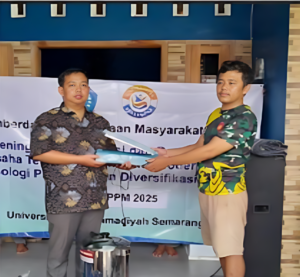
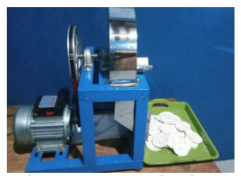
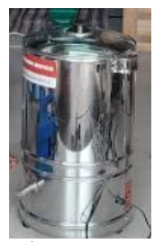
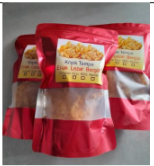
The community service program “Improving the Efficiency and Competitiveness of Javanese Tempeh Businesses through Modernization of Production Technology and Product Diversification” has had a tangible impact on the development of partner businesses. Several key points that can be concluded are: Increased Production Efficiency: The implementation of soybean washing machines, slicing machines, oil draining machines, and hand sealers has proven to accelerate the production process, improve hygiene, and standardize product quality. Product Diversification Achieved: Partners successfully produced better-quality tempeh chips that were crispier, had a longer shelf life, and featured more attractive, modern packaging. Improved Business Management: Through simple business management training, partners were able to record production costs, calculate the cost of goods sold, and develop a more systematic marketing strategy. Marketing and Branding: The “Javanese Tempeh” brand identity and digital marketing strategies were implemented, enabling the product to reach a wider consumer base, beyond traditional markets. Overall, this community service program successfully addressed the partners’ main challenges: limited production equipment, weak business management, and a lack of marketing strategies.