
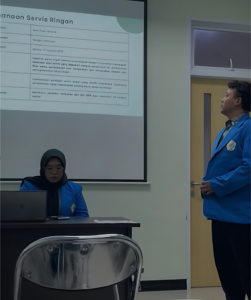
Semarang – Muhammadiyah University of Semarang (Unimus) once again demonstrated its commitment to community service through the Community Service Program. On Wednesday (September 17, 2025), two groups of students presented the final results of their community service in Pranggong Village and Kedungdowo Village, Andong District, Boyolali. The presentations took place at the Nursing Research Center (NRC) and the Joint Lecture Building (GKB 3) of the Unimus Semarang Postgraduate Program, and were attended by Field Supervisors and academics.
The first group, assigned to Pranggong Village, raised the theme “Community Empowerment through Agricultural Technology Innovation, Health Digitalization, and Sustainable Waste Management.” For one month, 15 students implemented various programs focused on solving local problems.
They introduced a simple fertilizer spreading tool that helps farmers save energy and time, and trained residents in processing plastic waste into environmentally friendly paving blocks. In addition, the students provided digital marketing training using Canva for MSMEs, held savings education for elementary school students, and even provided leadership training for youth organizations.
The group leader, Eko Teguh Wibowo, stated that community participation was very high. “The community’s enthusiasm is proof that simple innovations can have a real impact on farmers, MSMEs, and even elementary school children,” he said.
Meanwhile, the second group, stationed in Kedungdowo Village, carried the theme “Planting Devotion in the Village, Reaping a Golden Indonesian Civilization.” Fifteen students implemented flagship programs, including a demonstration of making eco-friendly paving blocks from plastic waste, an eco-printing workshop using local leaves, and making aromatherapy candles from used cooking oil.
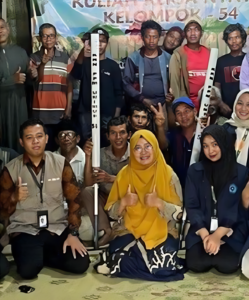
They also assisted residents in their work programs, successfully aligning with the program’s objectives. Individual programs enriched the activities, including Occupational Safety and Health (K3) training in workshops, minor motorcycle repairs, the development of a village drainage master plan, stunting prevention education, and financial literacy.
The group leader, Aldi Mashar Hairudin, emphasized that most of the programs were implemented well. “We brought not only theory but also real-world practices that residents can continue, from eco-friendly paving to the digitalization of grocery stores,” he said.
Field Supervisor, Prima Trisna Aji, commended the achievements of both groups. He assessed that the Community Service Program in Pranggong and Kedungdowo successfully provided direct benefits while producing academic outcomes. “All work programs ran well and received appreciation from the community. The students’ innovative work not only provided solutions but also produced outputs in the form of intellectual property rights (IPR) and books with ISBNs,” he explained.
The Community Service Program received a positive response from the community. Residents felt supported, both in terms of knowledge, skills, and new business opportunities. Some innovations even began to be implemented independently after the students returned to campus.
This success confirms that the synergy between universities, students, and villages can bring about real change and produce an innovative and empathetic young generation. Unimus, through Community Service Program, not only develops knowledge but also instills values of social concern and makes a real contribution to village development. The Community Service Program in Boyolali is proof that higher education can directly engage with community needs and provide sustainable solutions.