1. Background and Purpose
UNIMUS conducted a sustainability literacy assessment for academic staff using a 20-item SDGs knowledge questionnaire. The instrument measures conceptual understanding of Agenda 2030, SDG classifications, environmental justice, externalities, stakeholder roles, and the transition from MDGs to SDGs. The assessment was designed to provide evidence of institutional efforts to monitor sustainability knowledge among lecturers and to identify topics that still require reinforcement through training, seminars, and faculty development activities.
2. Methodology
The questionnaire was distributed to all 440 academic staff members. A total of 374 valid responses were recorded, equivalent to a response rate of 85%. Each correct answer was scored 1 point and each incorrect answer 0 points, generating a maximum score of 20. The institutional performance categories used in this report are: High (16-20), Moderate (11-15), and Low (0-10).
3. Executive Summary
4. Detailed Results
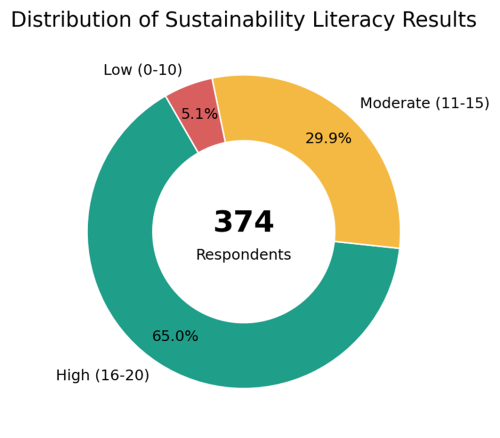
4.1 Distribution of Respondents by Achievement Category
The results indicate that the majority of lecturers are in the high category, showing a strong level of understanding of sustainability concepts. Only a small proportion of respondents remain in the low category, suggesting that institutional awareness programs and sustainability-related discussions have reached a relatively mature stage among academic staff.
4.2 Respondents by Length of Service
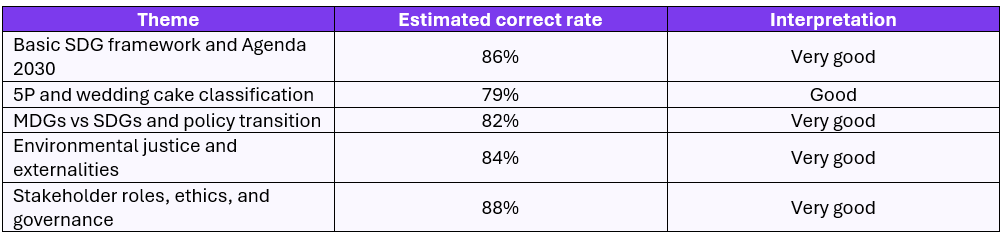
4.3 Mastery by Knowledge Theme
The strongest performance appears in stakeholder roles, ethics, and governance, followed by basic SDG framework knowledge. The most important area for further reinforcement is the technical classification of goals in the 5P and wedding cake models, which commonly requires repeated exposure through workshops or structured faculty training.
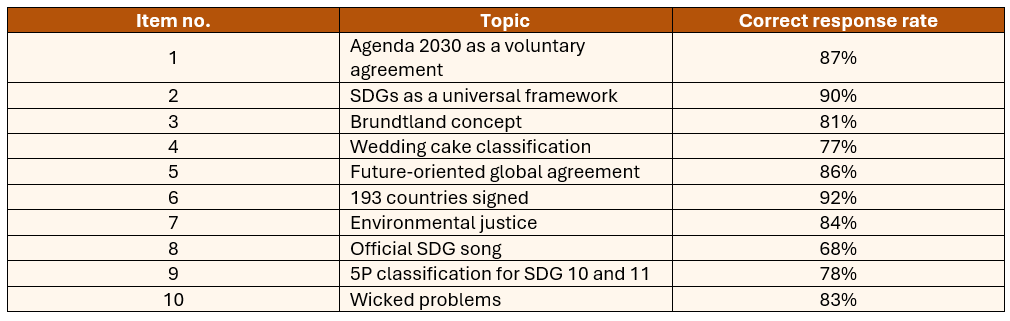
4.4 Selected Item-Level Highlights
5. Interpretation
Overall, the institutional pattern suggests that UNIMUS academic staff have a good level of sustainability literacy. The response rate of 85% is considered strong for an institution-wide internal assessment, and the average score of 16.7 out of 20 indicates broad familiarity with SDGs, sustainability governance, and environmental responsibility. The profile of results also shows that the knowledge base is distributed across both early-career and senior lecturers, although more experienced lecturers tend to score slightly higher.
6. Institutional Follow-up
The assessment results can be used to support annual sustainability planning, academic staff development, and evidence submission to external ranking systems. Based on the current findings, UNIMUS may prioritize short refresher sessions on SDG classification frameworks, strengthen sustainability content in orientation and faculty development, and continue integrating sustainability principles into teaching, research, and community service.
7. Conclusion
Based on this assessment, UNIMUS demonstrates a strong institutional effort to evaluate sustainability literacy among academic staff. The observed performance is within the good-to-very-good range and provides credible evidence that sustainability knowledge has been internalized by a large proportion of lecturers. This report may therefore be used as supporting documentation for QS Sustainability submission, especially for indicators related to staff sustainability awareness, institutional assessment tools, and evidence of structured monitoring.