
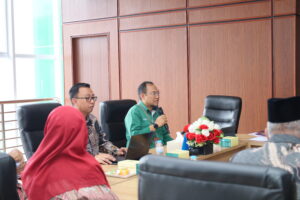
Semarang – Universitas Muhammadiyah Semarang (UNIMUS) received a benchmarking visit from Universitas dr. Soebandi Jember as part of efforts to strengthen the quality of higher education, particularly in developing a Faculty of Dentistry (FKG). Held in the VIP Meeting Room on the 9th floor of Joint Lecture Building (GKB) 3 at UNIMUS, the meeting was a space for sharing experience, reviewing institutional management practices and opening opportunities for collaboration in the Tri Dharma of higher education.
The visit was attended by the Rector of Universitas dr. Soebandi Jember, Andi Eka Pranata, S.ST., S.Kep., Ns., M.Kes., the Chair of the Foundation’s Board of Trustees, Vice Rectors I, II and III and staff. From UNIMUS, the FKG leadership attended, including the Dean, Vice Deans and other officials. UNIMUS Vice Rector III, Dr. Eny Winaryati, M.Pd., represented the Rector and welcomed the delegation.
In her remarks, Dr. Eny expressed appreciation for the visit by Universitas dr. Soebandi Jember. She said benchmarking is a two-way learning process that allows universities to learn from each other’s good practices and to look at aspects that can still be improved.
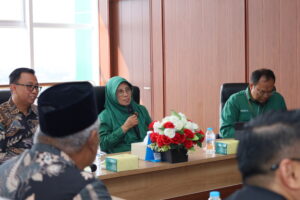
“Best practice does not mean we are better. We look at strengths but also at weaknesses, as material for evaluation and self-improvement,” said Dr. Eny.
She added that openness to input from other universities is an important part of building a culture of continuous quality improvement. The Universitas dr. Soebandi delegation was therefore also invited to see UNIMUS’ facilities, including those supporting medical and dental education.
UNIMUS has the UNIMUS Hospital and the UNIMUS Teaching Dental and Oral Hospital (RSGM), which are part of its education ecosystem and support learning and the development of students’ skills.
“Please don’t just attend this forum but also see our facilities. Feel free to look around so you can see UNIMUS’ facilities and environment for yourselves,” she said.
The Rector of Universitas dr. Soebandi Jember, Andi Eka Pranata, expressed appreciation for UNIMUS’ warm welcome and openness. He explained that the visit was intended to learn from UNIMUS’ experience in developing dental education.
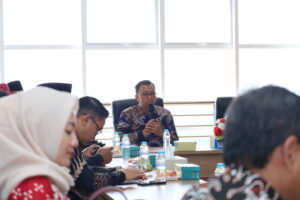
“We came here to learn and gain knowledge about how UNIMUS has developed dentistry. We hope what we learn here can be developed for the common good,” said Andi.
He said UNIMUS’ facilities and management of education are a valuable experience and a reference for Universitas dr. Soebandi in developing its own institution.
Besides learning about developing a Faculty of Dentistry, Andi hopes the meeting will be the beginning of a more lasting institutional relationship. He stressed that cooperation between universities should not only take the form of formal documents but must be translated into programs that are actually carried out.
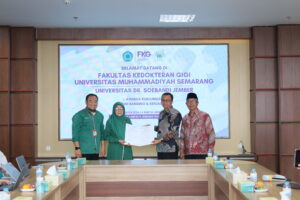
“We hope this relationship will continue, not only today’s meeting and an agreement on paper, but on an ongoing basis. We hope to collaborate more widely in the Tri Dharma,” he explained.
The collaboration can be developed in education, research and community service. Exchanging experience between the two institutions is also expected to broaden the horizons of their academic communities and open opportunities for joint programs.
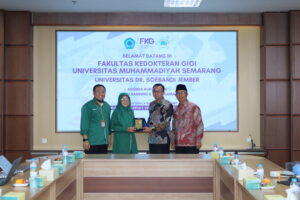
After signing a cooperation record, the two institutions held a discussion session. The forum discussed potential areas of future cooperation, especially in education, research, community service and the development of a Faculty of Dentistry.
Both sides exchanged ideas on concrete programs so that the cooperation does not stop at formal documents but produces activities that benefit the academic community and society.
Through the discussion, UNIMUS and Universitas dr. Soebandi Jember opened opportunities to keep strengthening communication and explore wider forms of collaboration in line with each institution’s potential and needs.
Through this benchmarking visit, UNIMUS again affirmed its openness to knowledge exchange and collaboration between universities. The spirit of mutual learning and sharing good practice is expected to raise the quality of higher education, strengthen the Tri Dharma and deliver innovations that benefit students, the academic community and society.
Reported by UNIMUS Public Relations (Irham)