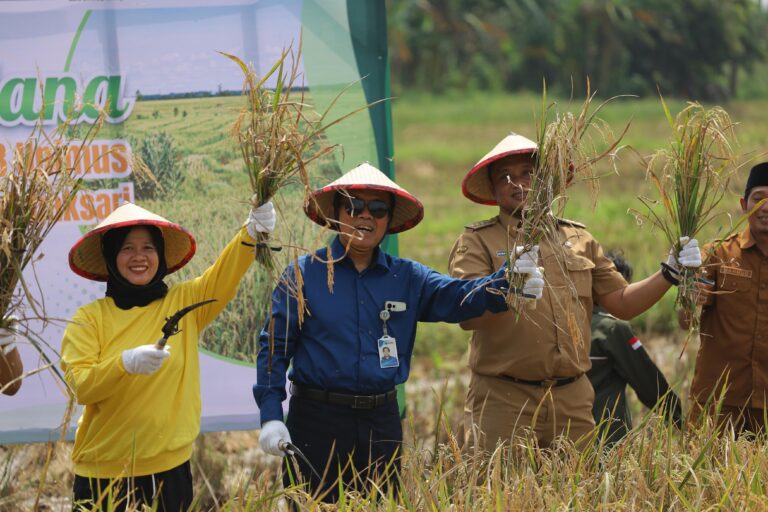
Kendal | (6/4/2026) As part of its commitment to supporting the agricultural sector, Universitas Muhammadiyah Semarang (UNIMUS), in collaboration with local farmers in Kendal Regency, carried out its first rice harvest from a continuous community assistance program. This milestone reflects the successful partnership between academia and the farming community in improving agricultural productivity. The harvest took place in Tambaksari Village, Rowosari District, as a result of collaboration between the Agribusiness Study Program of UNIMUS and local farmer groups (Gapoktan). From approximately 3,840 square meters of farmland, the harvest yielded around 2.5 tons of high-quality rice, demonstrating the effectiveness of the mentoring program. More than just a harvesting activity, this event highlights the strong synergy between universities, local government, and the community. Such collaboration plays a crucial role in boosting productivity and maintaining the stability of the agricultural sector at the regional level. Through this initiative, UNIMUS reaffirms its role as a higher education institution that not only focuses on academic excellence but also delivers practical solutions for society. The program is expected to enhance farmers’ welfare while strengthening local food security and independence. Moving forward, this collaboration is planned to be expanded to reach more farmer groups, aiming to build a more productive, sustainable, and competitive agricultural system.
Pesantren-Based Healthy Movement: Community Service Initiative by the Medical-Surgical Nursing Specialist Program of UNIMUS at the UNIMUS Boys’ Islamic Boarding School, Semarang
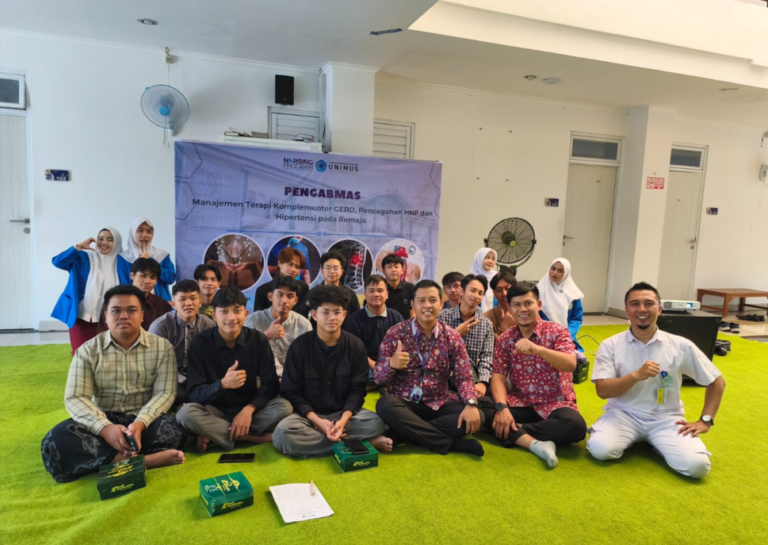
Semarang | The Medical-Surgical Nursing Specialist Program of Universitas Muhammadiyah Semarang (UNIMUS) once again demonstrated its strategic role in strengthening public health through a community service initiative focused on educational, promotive, and preventive approaches. The activity was held on Tuesday, March 31, 2026, from 09:00 to 12:00 WIB at the ground-floor hall of the UNIMUS Boys’ Islamic Boarding School in Semarang, involving 30 student participants. Carrying the theme “Pesantren-Based Healthy Movement,” the program aimed to enhance health literacy and foster preventive awareness of chronic diseases, particularly hypertension and musculoskeletal disorders. The activity was systematically organized, starting with participant registration, followed by hypertension screening through blood pressure measurement, and a barcode-based pre-test to assess participants’ initial knowledge. In her opening remarks, the Head of the Medical-Surgical Nursing Specialist Program at UNIMUS, Dr. Ns. Yunie Armiyati, S.Kep., M.Kep., Sp.Kep.MB, emphasized that the program primarily focuses on controlling chronic diseases through a comprehensive approach. She highlighted that Islamic boarding schools serve as strategic environments for shaping healthy lifestyles. Through this initiative, she expressed hope that awareness of chronic disease prevention could be instilled from a young age through continuous educational efforts. The first educational session was delivered by specialist student Pandu Aseta, who discussed Herniated Nucleus Pulposus (HNP). He explained that HNP occurs when the spinal disc protrudes and compresses nearby nerves, potentially causing radiating pain, muscle weakness, and mobility limitations. The session emphasized the importance of maintaining proper posture, engaging in balanced physical activity, and preventing injuries early, especially among individuals of productive age. Next, a lecturer of the Medical-Surgical Nursing Specialist Program at UNIMUS, Prima Trisna Aji, introduced an innovative concept titled SMART LIVING APPROACH as a strategy for preventing hypertension among pesantren students. He explained that this integrative approach focuses on adopting healthy lifestyles, regular physical activity, stress management, and independent health monitoring. According to him, pesantren students have significant potential as agents of change in creating a sustainable healthy environment. The activity continued with an interactive discussion session led by the Program Secretary, Warsono, focusing more deeply on musculoskeletal diseases. The participants’ enthusiasm was evident through the number of questions raised, reflecting increased awareness of the importance of maintaining health from an early age. To reinforce the learning experience, the session also included live demonstrations by the speakers on preventive practices and health management. The event concluded with a question-and-answer session, distribution of door prizes, and a group photo as a symbol of collaboration between the academic community and the pesantren. Through this initiative, the Medical-Surgical Nursing Specialist Program of UNIMUS Semarang not only provided health education but also fostered a sustainable, community-based health movement. The pesantren is expected to serve as a center for promoting healthy lifestyles while producing a generation that excels not only spiritually but also in physical well-being.
UNIMUS and SDCA Philippines Renew International Partnership, Strengthening Global Academic Collaboration
March 13, 2026 | Bacoor City, Philippines – St. Dominic College of Asia (SDCA) Auditorium Universitas Muhammadiyah Semarang (UNIMUS) has once again reaffirmed its commitment to expanding global academic networks by renewing its Memorandum of Understanding (MoU) with St. Dominic College of Asia (SDCA). The signing of this renewed agreement took place on March 13, 2026, at the SDCA campus. The event was attended by the President of SDCA, Dr. Gregorio A. Andaman, Jr., and the Vice Rector IV for Cooperation and Development of UNIMUS, Dr. Muhammad Yusuf. This renewal marks a strategic milestone in strengthening the long-term partnership between the two institutions, which share a common vision of enhancing the quality of higher education through international collaboration. updated agreement, UNIMUS and SDCA are committed to further developing a range of collaborative programs. These include faculty exchange, guest lectures, Global Classroom initiatives, involvement of adjunct professors, joint research, and academic supervision across various levels of education. In addition, both institutions will expand cooperation in curriculum and academic program development, the organization of seminars and training, cultural and academic exchanges for students and staff, and joint scientific publications. The agreement also opens opportunities to explore new areas of collaboration aligned with the evolving needs of higher education in the future. The five-year agreement also includes the establishment of a joint working group responsible for overseeing program implementation, monitoring progress, and preparing reports on collaborative activities. The renewal of this partnership reflects the strong commitment of both UNIMUS and SDCA to fostering impactful international collaboration. This initiative is expected to enhance the quality of education, strengthen research and community service, and create broader global opportunities for students, faculty members, and academic leaders. By continuously expanding its international network, UNIMUS reinforces its position as an adaptive, innovative, and globally oriented higher education institution. Meanwhile, its sustained partnership with SDCA highlights a tangible example of cross-border synergy in preparing future academics to face global challenges.
UNIMUS Participates in REL Week 2026 at SDCA Philippines, Strengthening Global Recognition through Academic Contributions
March 10–13, 2026 | Bacoor City, Philippines Universitas Muhammadiyah Semarang (UNIMUS) once again demonstrated its commitment to expanding international academic networks by actively participating in the 6th Research, Extension, and Linkages (REL) Week, organized by St. Dominic College of Asia (SDCA) from March 10–13, 2026, in Bacoor City, Philippines. The event was officially opened by the President of SDCA, Dr. Gregorio A. Andaman, Jr., alongside the Vice President, Dr. Nilda Balsicas. In their remarks, both emphasized the importance of global collaboration in strengthening research, community engagement, and international academic linkages. At this international academic forum, UNIMUS sent three representatives as speakers: Afifah Khairunnisa, M.Kes, Dr. Satria Pranata, and the Vice Rector IV for Cooperation and Development at UNIMUS, Dr. Muhammad Yusuf. Their participation reflects UNIMUS’s active contribution to a global platform that brings together academics and practitioners from various countries. In addition to delegates from Indonesia, REL Week 2026 also featured international speakers, including Mr. Patrick Low from Alliance Institute Ltd, Singapore, and Dr. Ananya Manmathbhai Mehta from RMIT University Vietnam. The presence of speakers from different countries enriched the global perspectives shared throughout the discussions. Carrying the theme “SPARK: Sustainable Partnerships for Academic Research and Knowledge Engagement,” the event highlighted the importance of sustainable collaboration among higher education institutions, industry, and communities in fostering innovation, research, and knowledge exchange. UNIMUS’s involvement extended beyond academic forums to the Global Classroom program. In this initiative, Afifah Khairunnisa and Dr. Satria Pranata served as Adjunct Professors, delivering lectures directly to SDCA students. This engagement serves as a form of international recognition of the academic competence of UNIMUS faculty members. Furthermore, the UNIMUS delegation also participated in the 6th International Multidisciplinary Research Conference (IMRC), which provided a platform for interdisciplinary idea exchange and encouraged collaborative research to address global challenges. The presence of Dr. Muhammad Yusuf further strengthened UNIMUS’s strategic role in developing international partnerships, particularly in education, research, and community service. Through this participation, UNIMUS not only expanded its global network but also reinforced its position as a higher education institution actively contributing to international academic forums. This initiative represents a concrete step in enhancing the quality of the university’s tridharma through cross-border collaboration. UNIMUS’s involvement in REL Week 2026 also reflects its ongoing commitment to advancing the internationalization of higher education and fostering impactful collaborations that contribute to the development of knowledge and the sustainability of global society.
UNIMUS Strengthens Its Strategy Toward Becoming a World-Class University Through Global Rankings
Semarang | Universitas Muhammadiyah Semarang (UNIMUS) continues to intensify its strategic efforts to achieve World-Class University status by enhancing institutional quality and actively participating in various international university rankings. This was conveyed during the university leadership meeting attended by the Rector, Vice Rectors I to III, and other university leaders. The meeting focused on reviewing UNIMUS’ progress in global rankings and formulating strategies to strengthen academic governance and institutional management. This leadership forum served as a strategic platform to present institutional achievements, evaluate work programs, and design future steps to enhance UNIMUS’ academic reputation at both national and international levels. Vice Rector I, Prof. Dr. Budi Santosa, M.Si., Med, explained that global university rankings have become a key indicator in measuring institutional quality and competitiveness worldwide. The rankings prioritized by UNIMUS include UI GreenMetric, QS Asia Rankings, and Times Higher Education (THE). Each ranking system applies different indicators. UI GreenMetric emphasizes sustainability, including campus layout, green open spaces, eco-friendly infrastructure, energy efficiency, and waste management. QS Asia Rankings focus on academic reputation and internationalization, including academic reputation, employer reputation, international networks, and global collaborations. Meanwhile, THE evaluates universities based on three core aspects: teaching, research, and global impact. Recently, UNIMUS achieved a significant milestone in the UI GreenMetric ranking, securing 59th place globally among approximately 592 universities. Regionally, UNIMUS ranked 2nd among private universities in Central Java. Within the Muhammadiyah and ‘Aisyiyah Higher Education institutions (PTMA), which consist of around 162 institutions, UNIMUS ranked 6th overall and became the top PTMA in Central Java. According to Prof. Budi Santosa, this achievement is the result of collective efforts from the entire academic community, particularly the significant contributions of the Institute for Research and Community Service (LP2M), which plays a central role in driving research and community engagement activities. As part of its strategy toward becoming a world-class university, UNIMUS has prepared several institutional strengthening programs, including developing an integrated institutional data system to support global rankings, positioning research as the primary driver of academic reputation, and strengthening postgraduate programs, including doctoral pathways. In addition, UNIMUS continues to promote the internationalization of academic activities, enhance the quality and capacity of lecturers, strengthen graduate competitiveness through industry collaboration, and establish sustainability as a core institutional identity. These strategies will be implemented gradually through a structured development roadmap. The Rector, Prof. Dr. H. Masrukhi, M.Pd, also highlighted academic developments, including the opening of several new study programs as part of strengthening institutional capacity. These include undergraduate programs in Artificial Intelligence, Visual Communication Design, Business Law, Professional Dietitian Education, Specialist Medical Education in Obstetrics and Gynecology, Master’s programs in Management and Informatics, and a Specialist Program in Medical-Surgical Nursing. According to the Rector, these programs are strategic responses to the rapid development of science, technology, and the evolving needs of industry and healthcare services. He also reminded all units to adjust operational activities during national holidays and Eid al-Fitr in accordance with government policies, including Work From Anywhere (WFA), collective leave, and national holidays. The meeting also highlighted that as of December 2025, UNIMUS students come from across Indonesia, from Aceh to Papua, indicating the university’s growing national recognition. The university remains committed to providing the best educational services to all students. Meanwhile, Vice Rector III, Dr. Eny Winaryati, M.Pd, emphasized the importance of student character development through strengthening leadership, discipline, and academic motivation. Lecturers are expected to continuously mentor and motivate students to help them overcome academic and social challenges. With these achievements and strategic initiatives, UNIMUS is optimistic about continuously improving its academic reputation and strengthening its global contribution as a competitive international university.
Instilling Islamic Values in Graduating Students, UNIMUS Holds Baitul Arqam Post-Study Program for the 48th Graduation
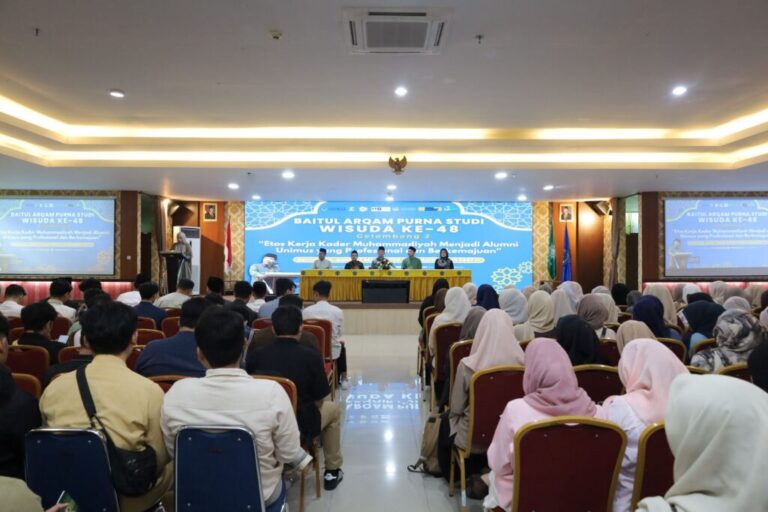
Semarang | Universitas Muhammadiyah Semarang (UNIMUS), through the Institute for Al-Islam and Muhammadiyah Studies (LSIK), organized the Baitul Arqam Post-Study Program (BAPS) for the 48th Graduation, Wave 2, in 2026 on Saturday, March 7, 2026, at the 8th Floor Hall of GKB 2, UNIMUS. This program serves as a final character-building stage for graduating students before participating in the official graduation ceremony. A total of 664 prospective graduates took part in this activity, aimed at strengthening Islamic and Muhammadiyah values. Through this program, graduates are expected not only to possess strong academic competencies but also to demonstrate religious character and moral integrity as they enter professional life and society. The event began with participant registration, followed by a collective Qur’an recitation session led by Dr. Ali Imron, M.Pd.I. The solemn atmosphere continued into the opening session, which included the recitation of verses from the Holy Qur’an, followed by the singing of the Indonesian national anthem “Indonesia Raya” and the Muhammadiyah anthem “Sang Surya.” In his remarks, the Head of LSIK UNIMUS and Chair of the Committee, Dr. Rochdi Wasono, M.Si., stated that Baitul Arqam is an integral part of student character development that has been carried out since the beginning of their academic journey until the final stage before graduation. He also congratulated the graduating students and expressed hope that their academic achievements would bring pride to their families, benefit themselves, and contribute positively to society. Furthermore, he emphasized that the values instilled during their studies at a Muhammadiyah university are expected to serve as a foundation for facing future life challenges. The program was officially opened by the Vice Rector I, Prof. Dr. Budi Santosa, M.Si., Med, who highlighted that education at UNIMUS is not solely focused on academic achievement but also on developing character and universal moral values. He noted that Islamic values such as honesty, discipline, and compassion are universal and can be embraced by people from all backgrounds. Therefore, education at UNIMUS is inclusive and open to students of diverse religious and social backgrounds. He also expressed appreciation to the participants for completing their studies, acknowledging that each student has undergone a unique journey toward graduation. In Session I, the Rector of UNIMUS, Prof. Dr. H. Masrukhi, M.Pd., delivered a lecture on “The Work Ethic of Muhammadiyah Cadres: Becoming Professional and Progressive Alumni.” In this session, participants were encouraged to develop a strong work ethic, integrity, and a progressive mindset as future alumni. Session II featured a review and practical training on religious practices, including ablution (wudhu), ritual bathing (janabat), daily prayers, and the implementation of combined (jamak) and shortened (qashar) prayers. This session was guided by LSIK instructors to strengthen both understanding and practice of religious obligations. Through the Baitul Arqam Post-Study Program, graduates of Universitas Muhammadiyah Semarang are expected to become individuals who excel academically while also embodying strong Islamic character, moral integrity, and the ability to contribute positively to society.
UNIMUS Distributes Affordable and Free Basic Food Packages for Employees as a Form of Campus Social Care
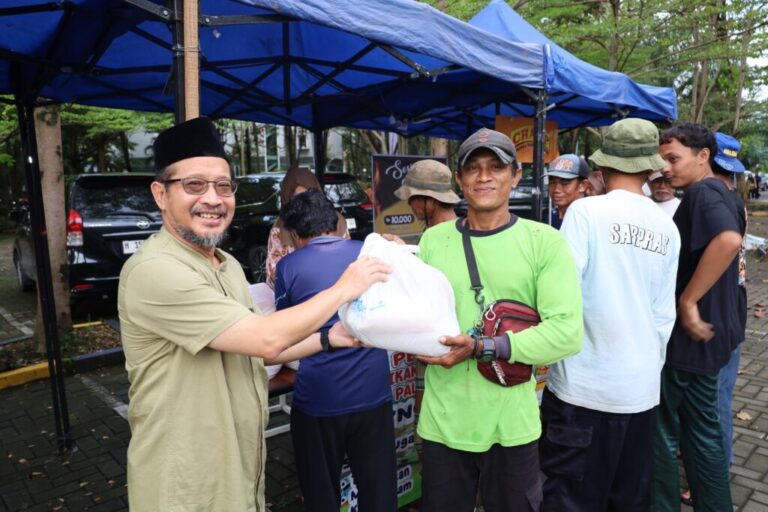
Semarang – Universitas Muhammadiyah Semarang (UNIMUS) demonstrated its commitment to employee welfare by organizing a program to distribute affordable and free basic food packages. The initiative was carried out by the Institute for Islamic and Muhammadiyah Studies and General Courses (LSIK&MKU) in collaboration with Unimus Mart and Lazismu on Friday, March 7, 2026, at the Unimus Mart courtyard. This program was part of the Gebyar Ramadan 1447 Hijri series, involving all UNIMUS employees. It aimed to help ease the burden of meeting daily basic needs, especially during the holy month of Ramadan. Through this initiative, UNIMUS provided subsidized basic food packages that employees could purchase at lower prices. In addition, free food packages were distributed to supporting staff within the campus, including cleaning service personnel, daily workers, and other supporting employees, as a form of special appreciation and assistance. The Head of LSIK&MKU UNIMUS, Dr. Rochdi Warsono, M.Si., attended the event along with other officials. His presence reflected the institution’s direct support and engagement with employees benefiting from the program. In his statement, Dr. Rochdi Warsono emphasized that this initiative represents a tangible effort by the institution to support employees in fulfilling their essential needs. He added that while the subsidized program was intended for employees in general, the free food assistance was specifically targeted at supporting staff who play a vital role in campus operations. Through this activity, UNIMUS hopes to strengthen solidarity and foster a sense of social responsibility within the campus community. The program also reflects the institution’s commitment to promoting humanitarian values and a culture of mutual care.
UNIMUS Explores Double Degree Collaboration with ABE UK to Strengthen International Academic Partnerships
Semarang | Universitas Muhammadiyah Semarang (UNIMUS) welcomed a delegation from the Association of Business Executives (ABE UK) on Friday, February 20, 2026. The visit aimed to introduce and discuss potential collaboration on a double degree program with several leading universities in the United Kingdom. The ABE UK delegation was received by the Vice Rector IV of UNIMUS along with program leaders. During the meeting, both parties explored academic collaboration schemes that would enable UNIMUS students to obtain dual degrees—one from UNIMUS and another from partner universities in the UK. This double degree initiative is considered a strategic step toward advancing the internationalization of higher education. In addition to providing students with access to global learning opportunities, the collaboration is expected to enhance curriculum quality, strengthen academic standards, and align programs with international qualifications. The Vice Rector IV of UNIMUS stated that the partnership with ABE UK could motivate faculty members to continuously improve international accreditation of study programs. This effort aligns with UNIMUS’s vision to enhance the global competitiveness of its graduates. Through this collaboration, UNIMUS students will have opportunities to broaden their perspectives, gain cross-cultural experiences, and improve professional competencies in line with international standards. Meanwhile, lecturers are encouraged to expand academic networks and develop research collaborations with international institutions. It is hoped that this partnership between UNIMUS and ABE UK will serve as a gateway to broader international opportunities for the entire UNIMUS academic community in the future.
UNIMUS Conducts Training on Supporting Students with Disabilities to Strengthen Inclusive Campus Services
Semarang | Universitas Muhammadiyah Semarang (UNIMUS) organized a training program on handling and supporting students with disabilities as part of its commitment to strengthening inclusive and sustainable student services. The program featured Wuri Handayani, Head of the Disability Services Unit (ULD) at Universitas Gadjah Mada, as the keynote speaker. The event was attended by the Vice Rector III for Student Affairs, Eny Winaryati, the Head of the Student Affairs Bureau (BAK), Fitria Fatichatul Hidayah, faculty leaders, and lecturers representing student volunteers within UNIMUS. In her opening remarks, the Vice Rector III expressed hope that the program would provide valuable insights and enhance the capacity of the academic community in addressing the needs of students with disabilities comprehensively. She emphasized that student affairs encompass a broad range of responsibilities, from addressing student-related issues to fostering student achievements. She also highlighted emerging challenges brought about by technological advancements, such as online gambling, online lending, and the increasing demand for specialized services for students with disabilities. These issues, she noted, require serious attention due to their long-term impact on the quality of student services. Furthermore, she explained that through the facilitation of BAK and the strengthening of eight pillars of student services, various challenges can be managed in a more structured manner. The program is designed to start at the study program level and gradually expand to the university level in a sustainable way. The training also underscored the important role of student volunteers in supporting social initiatives on campus, particularly as companions for students with disabilities. Volunteers are seen as a source of inspiration and a tangible expression of student empathy and social responsibility. She added that volunteers are individuals driven by a strong willingness to help others. This initiative is expected not only to bring meaningful value but also to enhance awareness and sensitivity toward various types of disabilities, including physical, mental, and social conditions. Meanwhile, Wuri Handayani explained the concept of inclusive education and strategies for training and mentoring students with disabilities in higher education. She emphasized that support services should not be limited to physical accessibility but must also include academic assistance, psychosocial support, and the development of students’ independence. Through this training, lecturers and educational staff are expected to improve their understanding of how to deliver disability-friendly services. Moreover, the program reinforces UNIMUS’ commitment to building an inclusive campus that is responsive to the diverse needs of its students.
FTIK UNIMUS Welcomes UMPSA Delegation, Strengthening Research and Academic Collaboration in Electrical Engineering and Science
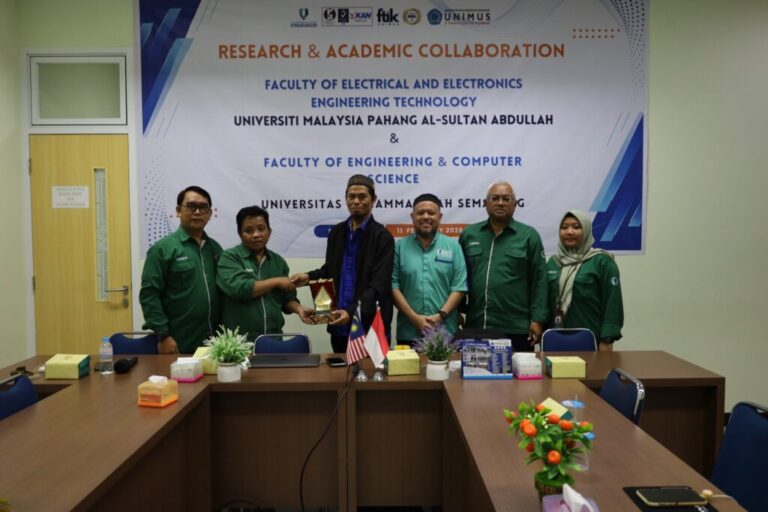
Semarang | The Faculty of Engineering and Computer Science (FTIK) at Universitas Muhammadiyah Semarang (UNIMUS) welcomed a delegation from Universiti Malaysia Pahang Al-Sultan Abdullah (UMPSA) on Wednesday, February 11, 2026. The delegation included Mohd Shawal Bin Jadin and Mohd Shafie Bin Bakar. This visit marked an important milestone in strengthening international collaboration, particularly in research and academic development in electrical engineering and science. The UMPSA delegation was warmly received by the Dean of FTIK UNIMUS, Dr. Ir. Tech. Syamsudi Rahardjo, along with the Vice Dean, heads of study programs, and lecturers. The meeting took place in a collaborative and enthusiastic atmosphere, reflecting both institutions’ commitment to building a sustainable academic partnership. This visit was part of a Research and Academic Collaboration initiative between the Faculty of Electrical & Electronics Engineering Technology at UMPSA and FTIK UNIMUS. The collaboration aims to promote joint research, academic exchange, and the enhancement of human resource quality in both institutions. In his remarks, the Dean of FTIK UNIMUS expressed appreciation for the visit, emphasizing that international collaboration is a strategic step toward improving the quality of higher education, particularly in engineering and technology fields. He highlighted that such partnerships provide opportunities for sharing knowledge, experiences, and ideas, which are essential for advancing academic quality and human resource development. He also noted that this collaboration is expected to generate innovations in both research and curriculum development, while enabling both institutions to adopt best practices to strengthen global competitiveness. Meanwhile, Mohd Shawal Bin Jadin, representing UMPSA, expressed enthusiasm for the collaboration with UNIMUS. He emphasized that international partnerships are crucial for higher education institutions to keep pace with rapid advancements in science and technology. He added that both universities plan to develop various collaborative programs, including joint research, academic strengthening initiatives, student exchange programs, and other scientific activities that can benefit both institutions. Furthermore, he underlined the importance of global networking in higher education, stating that collaboration enables institutions to exchange knowledge, broaden perspectives, and accelerate innovation. The meeting also featured academic discussions on potential joint research in electrical engineering, electronics, and applied sciences. Lecturers from both institutions presented their research potentials, flagship programs, and opportunities for developing internationally collaborative curricula. This visit is expected to serve as a concrete first step in establishing a strategic partnership between FTIK UNIMUS and UMPSA. Through sustained collaboration, both institutions are optimistic about enhancing educational quality, strengthening research capacity, and producing globally competitive graduates.