
Semarang – Job opportunities abroad for skilled Indonesian workers continue to grow as global demand for labour rises. This encourages universities to play a role in preparing human resources with not only academic competence but also the skills required by international labour markets.
This was one of the topics discussed during a visit by the Central Java Indonesian Migrant Workers Protection Agency (BP2MI) to Universitas Muhammadiyah Semarang (UNIMUS) on Wednesday (2/9/2026). The meeting took place in the Rectorate Meeting Room on the 2nd floor of UNIMUS and was hosted by UNIMUS Vice Rector IV, M. Yusuf, Ph.D., together with deans, vice deans, heads of study programs and staff of the UNIMUS International Relations Office (IRO).
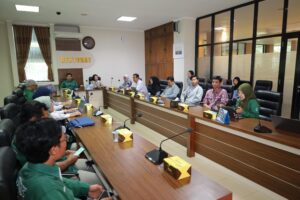
The visit was an opportunity to explore collaboration between BP2MI Central Java and UNIMUS, particularly in building the capacity of prospective Indonesian migrant workers, providing information on overseas job opportunities and strengthening the skills needed to enter the global labour market.
The Head of BP2MI Central Java, Dewi Ariani, S.H., explained that BP2MI Central Java is a technical service unit that provides protection and placement services for prospective Indonesian migrant workers and Indonesian migrant workers in Central Java.
She said one program that could be developed with universities is the Migrant Center, designed to create an information and capacity-building centre on overseas job opportunities within universities.
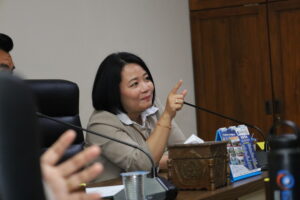
“The Migrant Center program is run in cooperation with universities. We hope that through the Migrant Center, all information related to job opportunities and capacity building will be available at the university,” Dewi explained.
She added that the Migrant Center is intended not only for students of the host university but also to benefit the wider public through access to information, capacity building and facilities that support the preparation of prospective migrant workers.
Besides developing information centres, Dewi said the government is also working to improve the skills of Indonesian workers so that they can meet the needs of international labour markets.
She explained that there is a national program to prepare placement opportunities for 500,000 workers abroad. These opportunities, she said, must be matched by human resource readiness, especially in terms of skills.
“These 500,000 places for working abroad are not a government stake; they are opportunities for people who want to work,” she said.
Dewi stressed that competence is one of the key requirements for competing and working abroad. That is why synergy between government, universities, vocational institutions, training providers, certification bodies and industry is essential in building an ecosystem that prepares competent migrant workers.
“This program cannot move on its own. We must build good synergy with the relevant parties and regional governments,” she said.
In this ecosystem, universities have a strategic position in strengthening competence, particularly through vocational education, training, skills certification and the capacity building of students and graduates.
Dewi said preparing prospective migrant workers must be an ongoing process, from preparation and implementation to reinforcement and evaluation. Vocational education, vocational training and skills certification should work as one, so that prospective migrant workers not only gain skills but also have proof of the competence required before placement.
“Vocational education, vocational training and skills certification are one integrated whole,” she said.
In response, UNIMUS Vice Rector IV, M. Yusuf, Ph.D., said UNIMUS is a growing university with a diverse academic ecosystem. It currently has 9 faculties and 48 study programs that offer potential for various forms of cooperation.
M. Yusuf stressed UNIMUS’ openness to building collaboration with various institutions and strategic partners. He said the networks built should lead to programs that can grow and bring real benefits.
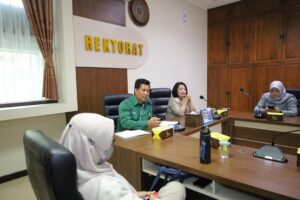
“We hope we can develop what we can do together and grow together,” said M. Yusuf.
He also introduced several UNIMUS facilities that are part of its educational ecosystem, including health facilities and academic strengths that can support the development of cooperation.
In the context of internationalization, the UNIMUS International Relations Office (IRO) also plays an important role in building networks and opening cooperation opportunities with a global dimension.
The meeting between UNIMUS and BP2MI Central Java is expected to be a first step in identifying more concrete forms of collaboration, including the possibility of a Migrant Center at the university, capacity building for students and graduates, and information on overseas job opportunities and the skills they require.
The collaboration also strengthens the role of universities in preparing Indonesia’s human resources to compete in the global labour market. Higher education is expected to produce graduates with not only a diploma but also competence, certification, experience and readiness for an increasingly open world of work.
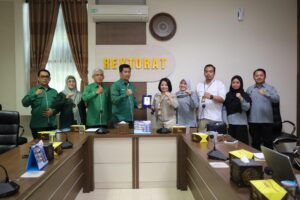
Through synergy between UNIMUS and BP2MI Central Java, opportunities for Indonesian workers to move into global labour markets are expected to be matched by adequate skills and protection. This effort is part of the university’s contribution to producing excellent, adaptable human resources able to seize opportunities amid changing global labour needs.